Hartford, Providence and Fishkill liner notes
These are track-by-track liner notes for my album Hartford, Providence and Fishkill, released on Ingrown Records 2025-11-21.
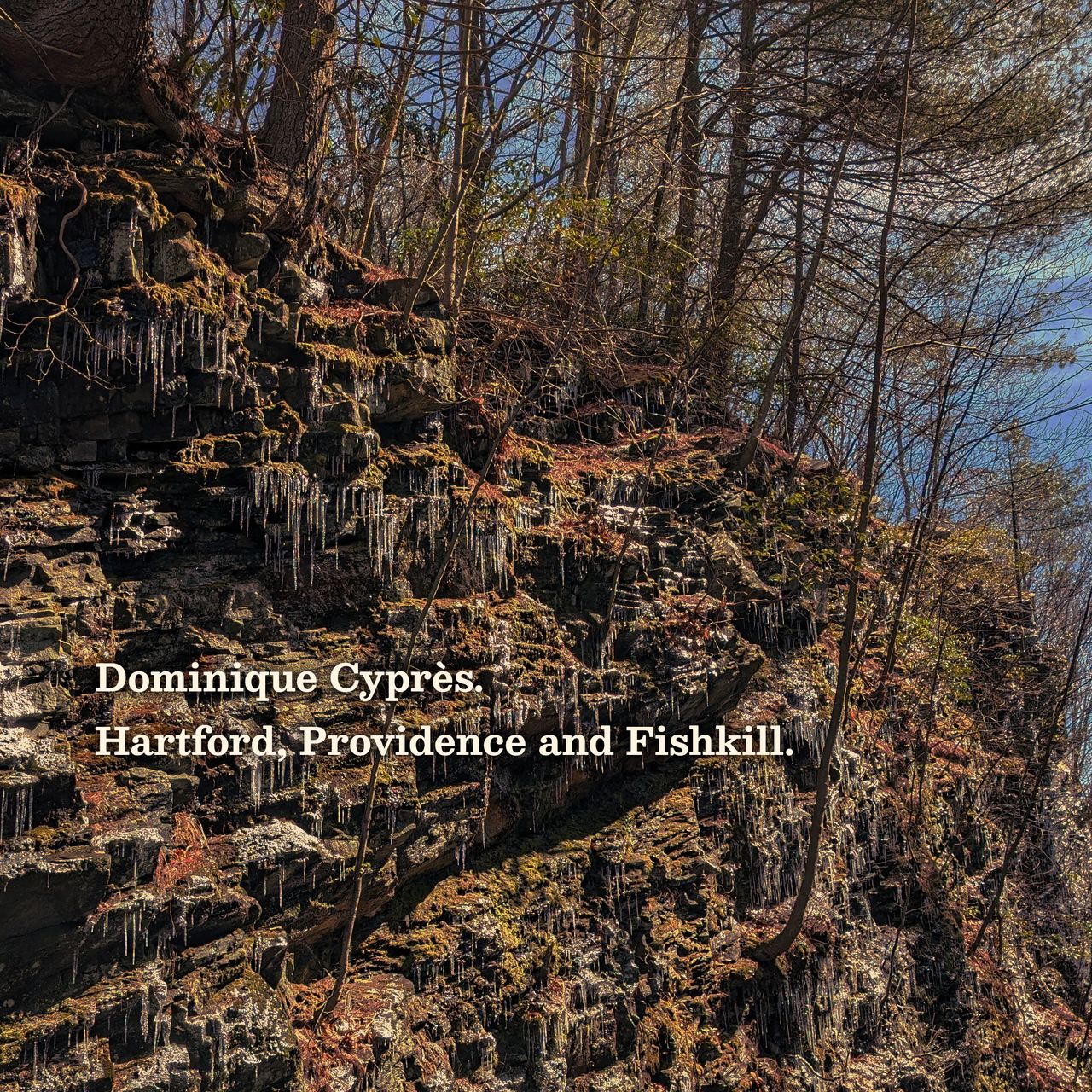
From the River
“The Jordan River is chilly and wide...”
Redwood Nurse Log
If a tree falls in a dense forest, it becomes the foundation of a rich new ecosystem.
I was born in New England and live in Connecticut now, but for six years of my childhood I lived in the Puyallup Valley region of western Washington. Compared to New England, the area tends to have pretty mild (if wet) weather year-round, and we did a lot of family day hikes in the woods, sometimes fairly close to home and sometimes a bit further away in places like the Paradise area of Tahoma (Mt. Rainier). Once we even took a road trip south to San José, California, stopping along the way to take in the unearthly ambiance of dense redwood forests. Sometime during all this hiking I learned about the concept of a “nurse log,” a fallen tree that nourishes saplings and other life on the forest floor.
The Late, Great Hannibal Lecter
Ridiculous and malign, all at once.
I composed this one very slowly. I began while I was preoccupied with the lead-up to the 2024 U.S. Presidential election. This is the source of the track's title, a strange turn of phrase because the famous fictional serial killer and cannibal Hannibal Lecter is neither “late”, being depicted as a living person, nor “great” in a traditional sense. It's therefore a facially ridiculous phrase, but also a threatening one in that it raises the specter of an archetypal killer in service of fomenting hostility toward immigrants. This is to say it captures well how I feel about my country right now.
Gulf of Deepwater Horizon
Soundtrack for a live video feed of crude oil leaking from a deep-sea wellhead.
Early 2025 saw some talk of renaming the Gulf of Mexico, and this is my suggestion. This album is more arranged than my previous work; this track and “Nightfishing” are the only two on it that were recorded live with improvisation, while all the others run from a sequencer.
Keyboard suite in D minor, HWV 437: IV. Sarabande
Composed by George Frideric Handel.
The sarabande is a dance originating in Spain, but this particular sarabande has a peculiarly haunting quality, and was referenced in Joe Hisaishi's requiem for the 1984 film Nausicaä of the Valley of the Wind. It was also a staple of a cassette I listened to in bed as a kid, The Classical Child, vol. 1, where it was arranged in airy music-box-like synth tones by Ernest Mavrides.
Pribislav Hippe
So hatte er sich an sein stilles und fernes Verhältnis zu Pribislav Hippe im Herzen gewöhnt und hielt es im Grunde für eine bleibende Einrichtung seines Lebens. Er liebte die Gemütsbewegungen, die es mit sich brachte, die Spannung, ob jener ihm heute begegnen, dicht an ihm vorübergehen, vielleicht ihn anblicken werde, die lautlosen, zarten Erfüllungen, mit denen sein Geheimnis ihn beschenkte, und sogar die Enttäuschungen, die zur Sache gehörten und deren größte war, wenn Pribislav „fehlte“: dann war der Schulhof verödet, der Tag aller Würze bar, aber die hinhaltende Hoffnung blieb.
—Thomas Mann, Der Zauberberg
In Thomas Mann's famous interwar novel The Magic Mountain, protagonist Hans Castorp, out hiking in the Alps, is abruptlu overcome by a memory from his youth, when he had an unspoken and unshakable infatuation for another boy in his class named Pribislav Hippe, which expressed only once by borrowing Pribislav's pencil. As Hans later pursues an affair with another patient (a married woman) at the sanatorium where they are being treated for tuberculosis, he views her always in comparison to this memory of Pribislav. The novel notes that Pribislav is not pronounced exactly as written, likely because the name is a Germanization of the traditional Czech name Přibyslav.
By varying the tempo of this piece a lot, and highlighting it with clicking percussion, I tried to create a sense of youthful uncertainty. The percussion reminds me of something caught in the wheel of a bicycle that is being propelled in fits and starts, or more abstractly of a young bird learning to fly.
Coventry Carol
Traditional. Musical composition recorded by Thomas Mawdyke, 1591.
The Coventry Carol stands out from the modern canon of Christmas carols in two respects. First, it is among the oldest widely-performed carols, dating back to at least the Renaissance. Moreover, it takes as its subject matter a singularly mournful aspect of the Christian nativity myth: the Massacre of the Innocents, an incident in the Gospel of Matthew in which Herod I, the historically attested king of Judea under Roman rule, is said to have responded to astrologers' prophecy of the birth of Jesus as a future king by ordering his soldiers to kill everyone in his kingdom aged two years and under, necessitating the Holy Family's temporary flight to Egypt as refugees. (While Herod himself was very much a real person, modern scholarship suggests the Massacre of Innocents is not a verifiable historical event, but instead a literary recapitulation of the circumstances of the birth of Moses in the book of Exodus.)
The carol appears in a mystery play, taking the narrative point of view of the mothers of the slain children:
Herod, the king, in his raging,
Chargid he hath this day
His men of might in his owne sight
All yonge children to slay...
In 2025, years into livestreamed siege warfare against civilian populations in both Ukraine and Gaza, there is certainly no way that a modern audience can relate to a story about imperial conquest and geopolitical maneuvering leading to the widespread, systematic killing and displacement of children. Thank goodness we live in a more civilized age!
Rockville Railroad
Rockville had already become a major manufacturing center, producing carloads of cloth from mills on the Hockanum River (which fell over 300' in a bit over one mile). The steady source of water provided a resource which enabled much manufacturing. There was a problem, however. The Hartford, Providence and Fishkill Railroad was chartered to reach the Hudson River and Providence. If the Railroad went through Rockville, the slope of the climb out of Rockville to the east made railroad construction impossible. Therefore, the Rockville RR branch line was constructed. So much money and manufacturing flowed into and out of Rockville that it became a major financial, industrial and business center.
—educational plaque, Hop River State Park Trail in Vernon, Connecticut
I tried to imagine the thrill of riding that railroad when it was new. It's still thrilling, in its own way, to walk or cycle the path of the old railroad as it snakes its way through the woods between small Connecticut towns, but the railroad itself is no longer there. Maybe the rhythm of the noise of the trains was just a little like the percussion on this track. But it probably wasn't, and I'll probably never know.
Funeral March for Gordon Cole
“Fix your hearts or die.”
When I heard that David Lynch had died I felt a little robbed; I had just been returning to some of his work and ideas, there were rumors about projects he had brewing, he had just been evacuated from the wildfires in Los Angeles, and I guess I wasn't ready. I felt I should write a little funeral march, and already in other tracks I had been referencing the main title theme Wendy Carlos recorded for A Clockwork Orange, which contains a passage from Henry Purcell's Music for the Funeral of Queen Mary. But I didn't actually know David Lynch, so it felt appropriate that I should instead write a funeral march for a fictional character he played on TV.
Blood-Dimmed Tide
The blood-dimmed tide is loosed, and everywhere
The ceremony of innocence is drowned...
—William Butler Yeats, “The Second Coming”
Here I tried using a physical-modeling kick drum synth module as a melodic voice by triggering it at audio rates. I can't decide whether it sounds like entropy rising to devour the world or just a lawnmower.
Peg's Dream
This track is named for my grandmother, who once described to me an eerily specific prophetic dream she had involving someone she hardly knew. I composed this track and the following two in the same sequence in which they appear here. I began working on “Peg's Dream” with a sense of melancholy that unexpectedly gave way to wistful doo-wop changes as I progressed.
Dialing In
I needed a little break after “Peg's Dream”, so I started experimenting with reckless pitch bends, using the dual-sine tones produced by telephone dialing as percussion. I felt that things were getting out of hand and cut it short. In the course of working on this track I learned that in the North American phone system the “dial tone” heard when a landline has not yet been dialed or has been disconnected from a call consists of combined 350Hz and 440Hz sine waves.
The End of All Things
This too shall pass.
As I wrapped up “Dialing In” I felt the melancholy that had spurred me into writing “Peg's Dream”, but this time it felt deeper-rooted and harder to grasp.
In 2025 I found myself thinking about the end of the world, maybe because on the internet images abound of other real people's own personal worlds ending right now under a rain of bombs. I thought about the insurmountable task of mourning all of it at once. It occurs to me now that David Bowie's classic song “Five Years” is about this:
my brain hurt like a warehouse
it had no room to spare
I had to cram so many things to store
everything in there
and all the fat-skinny people
and all the tall-short people
and all the nobody people
and all the somebody people
never thought I'd need so many people
But I wondered what it might sound like, and this is what I imagined. Some cosmic bugler emerges to pay whatever feeble tribute it can, holding on just a moment after everything else has faded to silence so it can deliver its last wavering note.
River Reprise
Slower this time, and a few semitones lower.
I tried playing most of the tracks on this album at very low speeds, and with lowered pitch. It's interesting to me how this can transform the emotional valence of the music. In one case I decided to share the result on this album.
Nightfishing
With a live introduction by some well-known local musicians.
This one evolved out of a demonstration patch I created in VCV Rack to explain basic concepts of digital signal processing and modular synthesis.
Prelude and Fugue in C minor, BWV 847
Composed by J.S. Bach.
My preferred environment for listening to The Well-Tempered Clavier is inside a strange, enormous organ.
I spent a long time tweaking the sound on this one but first recorded it while I was wrapping up my previous album South Tower. At the time I envisioned a concept album inspired by Miyazawa Kenji's novella Night on the Galactic Railroad. In that context I imagined the travelers on that inter-dimensional train might hear this faintly on the radio.
I have felt a little self-conscious about this one because the same piece appears on Wendy Carlos's classic album Switched-On Bach. I think my recording is different enough to justify its separate existence. It is more subdued. If you want a thrill I suggest seeking out Wendy Carlos's recording.
To the Sea
Where all rivers eventually flow.
Where not otherwise noted, the content of this blog is written by Dominique Cyprès and licensed under a Creative Commons Attribution-ShareAlike 4.0 International License.