That funny feeling in my tail
My tail is large, fluffy, ringed black and gray. Cartoonishly curved into a in a gentle S. Soft, impossible to hide. It marks me as a vulnerable, irrational, emotional animal. Maybe cute, maybe a nuisance, depending on your point of view. It was sewn by some lovely fursuit makers in Maryland.
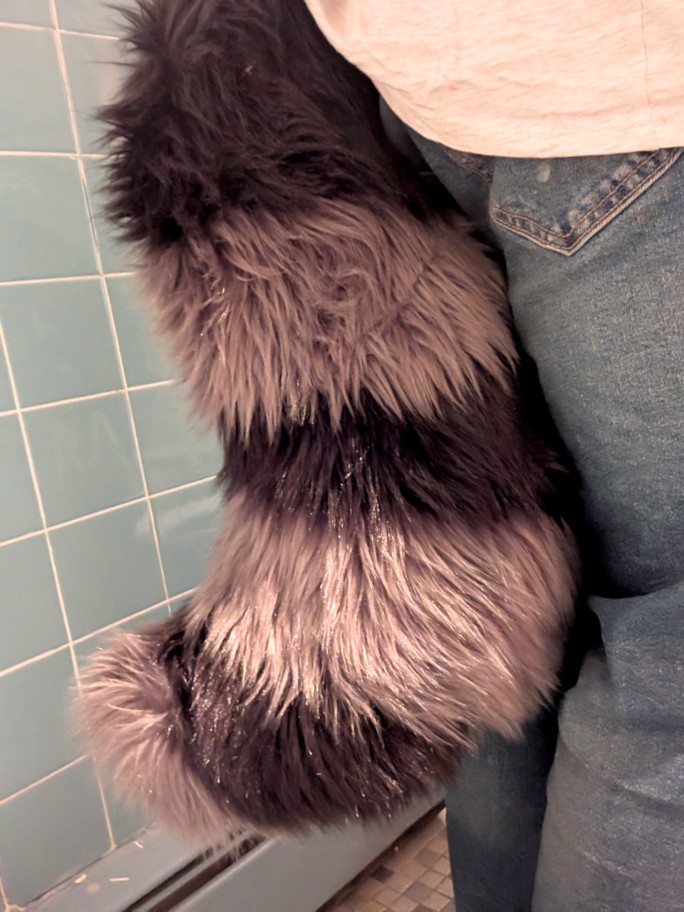
Why do I wear a tail? Why am I interested in a fursuit? Why be a raccoon? The honest answer is that it feels right and looks like fun. And I've written about how engaging with the furry critter part of my psyche enabled me to break through decades of emotional repression and feel finally like a whole and authentic person. But maybe it also reflects a few things about how I understand the world and where I fit into it.
Neurological models of the human brain posit a sensorimotor homunculus: a “little guy” that maps the neural inputs and outputs of the extremities of the body into an experiential whole. A person who has had a limb amputated may retain the corresponding part of the homunculus and experience phantom limb sensations like pain, tingling, warmth or coldness in the limb that is no longer externally present. I have a probably untestable suspicion that some of us retain some evolutionary memory of a tail within that homunculus; after all, the human skeleton retains the beginning of a tail in the form of a coccyx.
My favorite lyrical passage from Paul Simon's song “Graceland” is:
losing love is like a window in your heart everybody sees you're blown apart everybody feels the wind blow
What an image! I feel I need some kind of window in my heart or even I won't know what's in there. But it's terrifying to open that up, and tends to be achieved only through confronting loss. Non-human animals have always been key to the way I understand, imagine, and relate to vulnerability and especially my own vulnerability. Sometimes wearing a tail makes me feel like I've opened a little window in my heart.
I recently started playing the furry visual novel Chord Progressions. The player character is a chubby gay fox called Eddy who has just taken a new job at an independent music store and café. Early in the game Eddy stands in front of his closet mirror to choose his outfit for the day, starting with underwear. For me this scene elicited a startling sense of recognition, a feeling that I could see myself in this fox more than I ever do in a human character on screen. Uncanny self-recognition. Like catching your reflection in a velvet curtain. That's not supposed to be reflective!
I haven't progressed far in Chord Progressions due to time constraints, but I did complete the simpler, non-branching, novella-length 3 Days to Live, about player character Swift's experience at his first furry convention—specifically, Megaplex 2025 in Orlando, Florida. Chord Progressions is a dating sim, and 3 Days to Live centers on Swift's misadventures trying to date and hook up with some amount of desperation as this is something he basically can't do in his daily life as a gay office worker in Missouri. Swift inhabits the human world, but he and other furries are represented on-screen by their fursonas. Neither Eddy nor Swift is in an exact situation I know from experience; I kind of stumbled into the relationships I have now without ever having dated in a conventional way. Rather, it's Eddy's pose in the mirror and even moreso Swift's narration of his internal thoughts, self-concept, and sexual and romantic fantasies that are familiar; this is the type of guy I am even if we don't live the same life. I understand intuitively how Swift feels about his office, and what it is he sees in the men he pursues. This could just about be me in some parallel universe.
The stories about dating may not speak to my real life in a concrete way but they do clarify things about my inner experience. One thing I have only recently got in touch with is what kind of romantic I am. I've also discovered that deep down I have a pretty slutty personality, and this is something I like about myself, even if I have not really matched this facet of my inner nature with outward action.
I spent most of my adult life so far with a stunted capacity for fantasy of any kind—not only sexual or romantic, but even of the casual daydreaming variety. What I gained by learning to engage in fantasy through furry art and expression was a new groundedness in the immediate realities of my life. With a clearer picture of my internal self, I no longer despair that my human face in the mirror fails to reveal who I aspire to be. I have learned not to expect so much from it.
At times it feels a little unfair that I found this ability only now, at the age of thirty-four. Until now, I've basically appeared from a distance to be a pretty conventional usonian dad. People who don't know me have had a tendency to assume I was straight. It's not that I was ever trying to live “in the closet” exactly, but my attenuated relationship to my own body disincentivised dressing distinctively and my autistic flat affect tends to be read as straight. I had a strange feeling when I considered whether I wanted to buy a tail—there was the feeling of committing to something new, but there was another feeling I couldn't identify right away. It was simply the feeling of being excited to enjoy wearing something cute. I had been missing that for a long time, and since then I have found more ways to enjoy it. I even got my ears pierced.
We recently had a visit from my dad. My relationship with my dad right now is, I think, pretty good, and that makes it difficult for me to think about the possibility that he let me down in any significant way when I was growing up. But having gone so far in my life with such a reduced capacity for feeling and for really living largely because of patterns of thought I learned in order to hide nonconformance to a particular standard of masculinity… it's inescapable that I would have to consider one person in particular as having likely some responsibility in creating that situation. And as I pondered this our five-year-old commanded him to read picture books about how it's okay for boys to wear dresses, and my dad cheerfully obliged. It was a moment of joy. I was deeply grateful for what the three of us—my dad, my child, and I—had in that moment. It was also a moment of bitterness. How did it take us decades to get to this point? Did we really waste all that time?
Being autistic, gay, and gender-non-conforming, I have spent a lot of time in my life trying to act normal, very often without full awareness that I was doing so. Within autistic circles this has sometimes been called “masking”, although this term has become ambiguous since the use of surgical masks as a public health measure was politicized in 2020. To some extent I have experienced this behavior as a performance of humanity or personhood; I act human to retain access to my human rights and human dignity. I think a lot of people have to perform this act for different reasons. It is rooted in a healthy survival instinct to endear ourselves to our childhood caretakers, and becomes warped and maladaptive when we sense that positive regard is conditioned on impossible expectations. When I wear my tail I am dropping the act and taking a reprieve from the effort it takes to look human. I am also implicitly promising not to demand this effort from others.
In human society we have a tendency to take the lives of other kinds of animals for granted, to disregard or even celebrate their suffering. In some of the world's major religious traditions, the human species is regarded as uniquely possessing a soul, or possessing a soul fundamentally more important or noble than that of other animals. Over the course of human history, this posture toward non-human animals has escalated from subsistence cultures, in which predation is a direct experience understood in terms of immediate necessity, to industrial commodification of the animal, often enacted through an underclass of exploited laborers in facilities hidden from public view and at a scale responsive to abstract market demands. The dismissal of non-human experience in turn enables the subjugation of disfavored human classes through dehumanization. A class targeted for dehumanization is rhetorically labeled “cockroaches” or “vermin” to justify a revocation of human rights.
The flipside of the disregard for other forms of animal life is that we tend to exempt non-human animals from the need to justify one's own existence, which in contemporary capitalist systems is connected to the demand for one to earn a living. One may ask even a stranger at a party, “What do you do for a living?” But never have I heard it asked what a bonobo does that it should be allowed to live. In this way our bearing toward our non-human cousins hews closer to the deeper truth that our mortal existence is a gift that need not and probably can not be justified or earned. Instead, it can be shared, honored, and celebrated. As Jeff Mangum of Neutral Milk Hotel put it: “Can't believe how strange it is to be anything at all!”
One thing that fascinates me about raccoons is that in some contexts they are regarded as charismatic and adorable, in others as vermin or nuisance animals to be exterminated, and in some cases as merely a material resource in the industrial fur trade, where their lives are casually discarded. When I wear my faux-fur raccoon tail I assert my belief that I possess no soul fundamentally greater than that of a raccoon, or maybe that a raccoon possesses no less of a soul than I do. This belief has implications for the contingency of human rights and for our collective responsibility for our fellow-creatures. It also frees me from the obligation to justify my existence. The raccoon does not exist for any particular human purpose and neither do I. And nevertheless I'm here. We're all here together. And I have learned I have more love to share than I knew, for my partners, our children, friends, neighbors… the many creatures of this world.
Where not otherwise noted, the content of this blog is written by Dominique Cyprès and licensed under a Creative Commons Attribution-ShareAlike 4.0 International License.